

There are two main ways to weld a stud onto sheet metal: capacitor discharge (CD) and drawn-arc. They look similar from the outside — a metal stud, permanently fixed to a panel, ready to take a nut or a clip. But they work in very different ways, and picking the wrong one is how you end up with burn-through on thin sheet, a weak joint on thick plate, or a weld that costs more than it should.
This guide compares the two processes, so you can match the stud to the job before you order.
What Is Capacitor Discharge (CD) Stud Welding?
In CD stud welding, energy is stored in a capacitor bank and released through the tip of the stud in a few milliseconds. The arc is so short that the weld pool is tiny and almost no heat spreads into the sheet. There is no ceramic ferrule, no filler, and no shielding gas.
That makes CD the natural choice when the base metal is thin. It works on sheet as thin as 0.5 mm without marking the reverse side, which is why it is common in electronics enclosures, HVAC panels, control cabinets, and automotive trim. Typical stud sizes are M3 to M10, and a weld takes about a second, so it suits high-volume work.
The trade-off is penetration. The weld is shallow by design, so CD is not the process for large studs or heavy structural loads.
What Is Drawn-Arc Stud Welding?
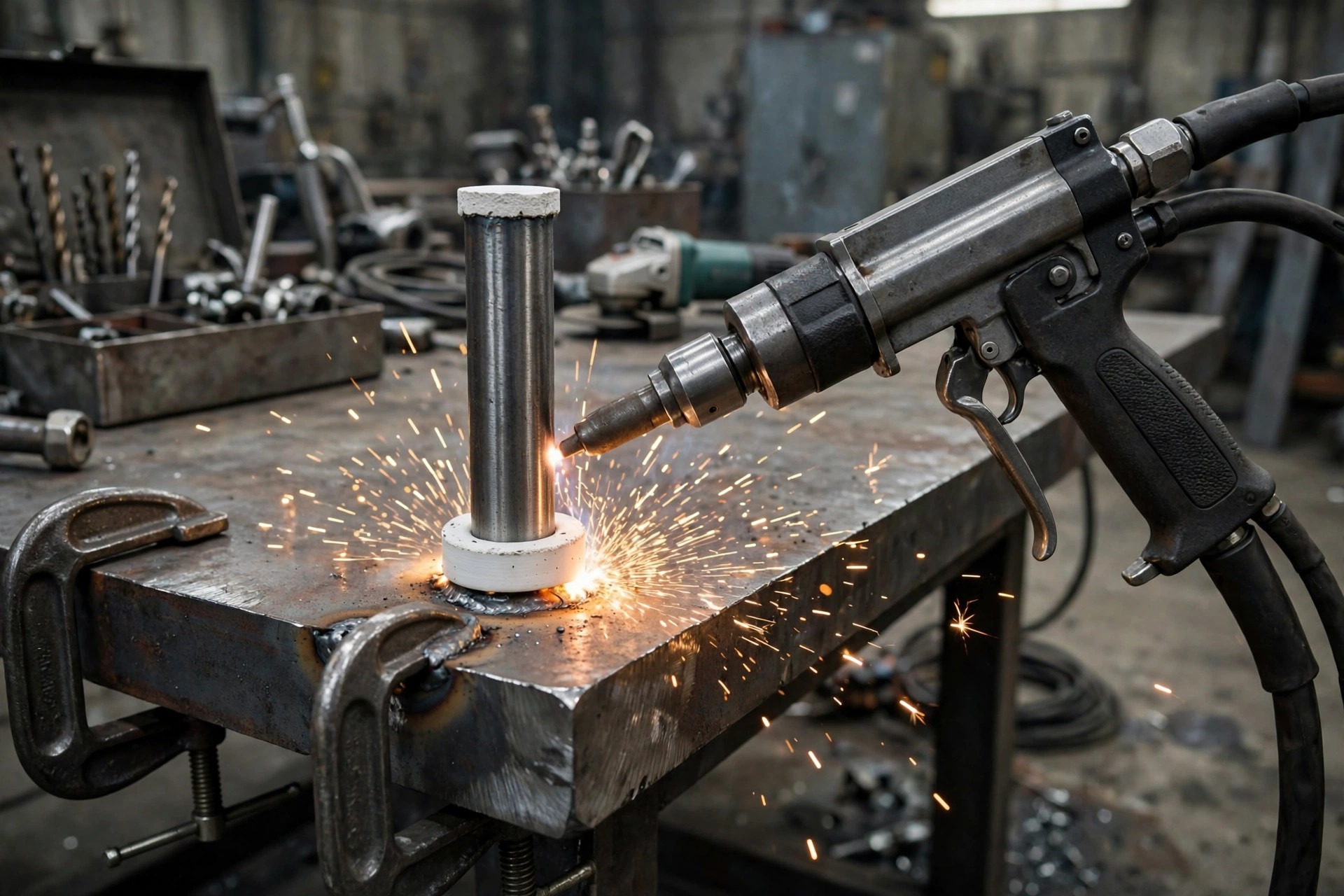
Drawn-arc welding works more like a miniature arc weld. The gun lifts the stud slightly off the workpiece, strikes an arc, and then plunges the stud into the molten pool. A ceramic ferrule sits around the weld: it shapes the fillet, shields the molten metal, and keeps spatter down. The ferrule is knocked off after the weld cools.
Because the arc burns longer and the pool is deeper, drawn-arc gives a full-penetration, structural-strength weld. It handles studs from M6 up to M25 and above, and base metal from about 2 mm upward. It is the standard choice for construction, shipbuilding, heavy equipment, and anywhere a stud has to carry a real load.
The price is heat and time. The process puts more heat into the part, it is slower per weld than CD, and the ferrule adds a small consumable cost.
CD vs Drawn-Arc at a Glance
| CD stud welding | Drawn-arc stud welding | |
|---|---|---|
| Stud size | M3–M10 (up to M12) | M6–M25 and above |
| Base metal thickness | From 0.5 mm | From about 2 mm |
| Heat into the part | Very low | Moderate to high |
| Weld strength | Good for light loads | Structural, full penetration |
| Speed | Very fast, ~1 second per weld | Slower per weld |
| Reverse-side marking | None | Possible on thin sheet |
| Ferrule needed | No | Yes, ceramic ferrule |
| Best for | Thin sheet, small studs, cosmetic parts | Thick plate, large studs, structural loads |
Which Process Does Your Job Need?
Four quick rules cover most jobs:
- Sheet under 2 mm? Use CD. Drawn-arc risks burn-through and visible distortion on thin material.
- Stud M12 or larger, or a structural load? Use drawn-arc. CD cannot give a large stud enough penetration.
- Visible or cosmetic surface? Use CD. There is no mark on the back of the panel and no ferrule to clean off.
- High volume of small studs? Use CD. The speed difference adds up fast over thousands of welds.
If your job sits between the two — for example, a 2 mm panel with an M8 stud — either process can work. In that case, the deciding factors are usually whether the back of the panel is visible and how many parts you are running.
4 Mistakes That Weaken a Stud Weld
1. Drawn-arc on thin sheet. The arc burns through or warps the panel. Thin sheet belongs to CD.
2. CD on thick plate with an oversized stud. The weld looks fine but stays shallow, and pull-out strength drops. Match the stud size to the process.
3. Skipping the ferrule on drawn-arc. Without it the pool is exposed, the weld turns porous, and spatter spreads across the part.
4. Mismatched materials. A carbon steel stud on a stainless sheet, or the reverse, can invite galvanic corrosion in a damp environment. Keep the stud material consistent with the base metal, or specify stainless throughout.
Hele’s Weld Stud Range
Hele Metal supplies both processes. The CD range covers PT threaded studs, UT unthreaded studs, and IT internally threaded studs; the drawn-arc range is the PD series. Materials are steel and stainless steel 304/316, and custom sizes are available. See the full range on the CD Weld Studs page.
If you are unsure which process fits your part, send us the drawing or the sheet thickness and stud size — we will confirm the right type before you order. Minimum order is 1,000 pieces. Contact us.