
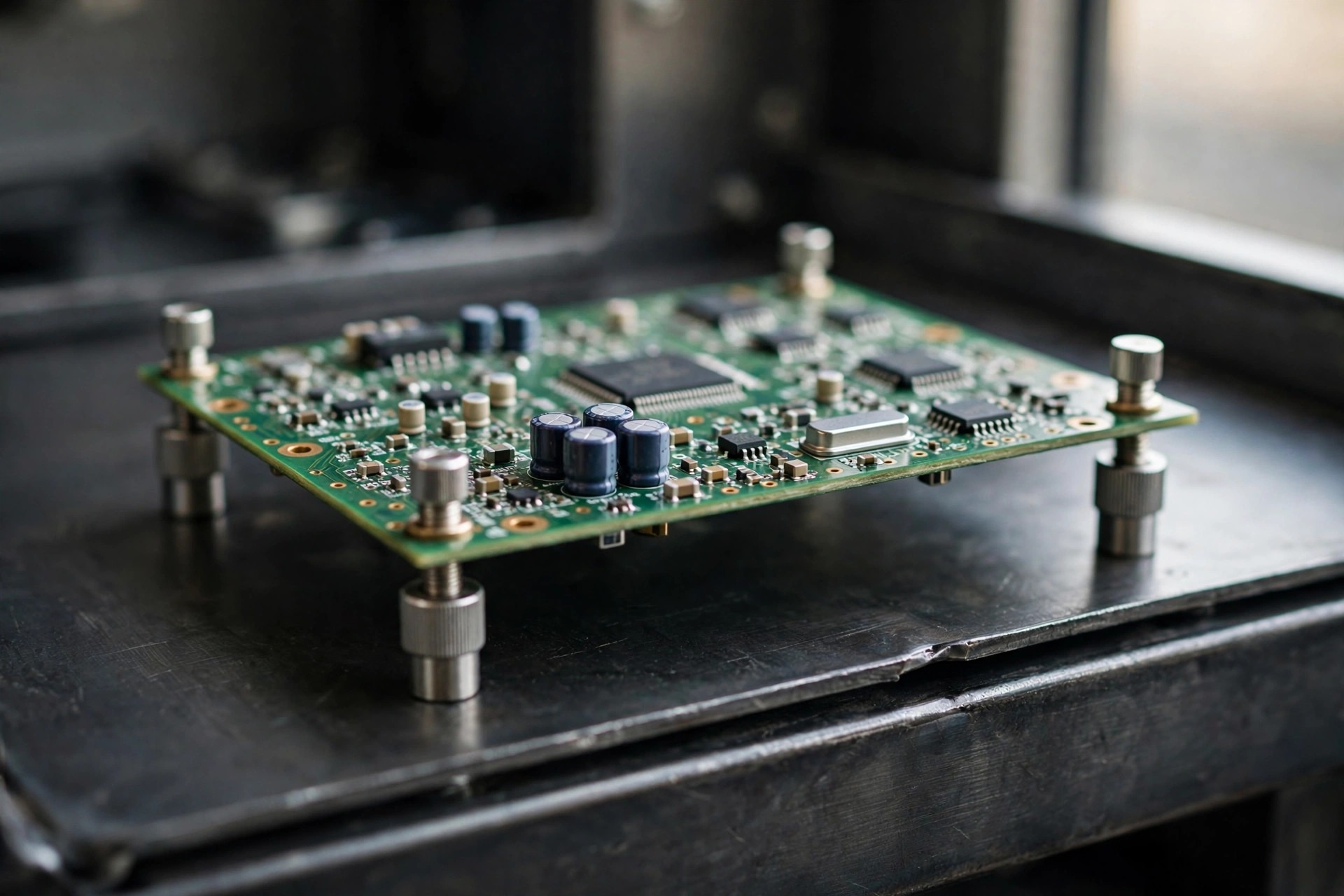
A printed circuit board needs to sit 10 mm above a metal chassis. A control panel needs a cover held off the frame by exactly the right gap. In both cases the problem is the same: thin sheet metal has no thickness to tap a thread into, and welding a standoff onto the sheet adds heat, distortion, and cost.
Self-clinching standoffs solve this by pressing into the sheet and staying there — a permanent, threaded spacer that needs no welding, no tapping, and no loose hardware. This guide explains the types, how they install, and how to choose the right one.
What Is a Self-Clinching Standoff?
A self-clinching standoff is a cylindrical fastener that is pressed into a punched or drilled hole in sheet metal. One end of the standoff has a clinch ring — a raised, knurled or serrated band slightly larger than the hole. When the standoff is squeezed into the sheet under pressure, the ring displaces the sheet metal around it, and the metal flows back into the grooves of the ring. The standoff is locked in place, flush on one side and standing proud on the other.
The result is a fixed, threaded (or unthreaded) spacer that is part of the panel. It cannot turn, it cannot pull out, and it adds no heat or distortion to the sheet. Boards, covers, and components can then be screwed onto it again and again.
How Self-Clinching Standoffs Work
Installation is a single press stroke, usually done in a press brake or an arbor press:

- Prepare the hole. Punch or drill a round hole of the specified diameter in the sheet. The hole size matters — too large and the standoff will not clinch, too small and the sheet can crack or the standoff will not seat.
- Place the standoff. Set the standoff into the hole with the clinch ring against the sheet.
- Press. Squeeze the standoff into the sheet. The clinch ring forces the surrounding metal to flow into its serrations, locking the standoff against rotation and pull-out.
- Done. The standoff is flush on the clinched side and stands at its specified height on the other side, ready for a screw.
The joint is only as good as the sheet: the panel must be hard enough to hold the clinch but not so hard that it will not flow. As a rule, the standoff should be harder than the sheet — steel standoffs for steel or aluminum sheet, stainless steel standoffs for stainless sheet.
Main Types at a Glance
| Type | Thread | Best for |
|---|---|---|
| Through-hole threaded (SO/SOS) | Threaded all the way through | Stacking boards or panels with a screw from either side |
| Blind threaded (BSO/BSOS) | Threaded, closed at the bottom | Mounting a board on top, where the screw must not poke through |
| Unthreaded (TSO/TSOS) | Smooth bore, no thread | Spacers that a screw passes through, or locating pins |
| Swage standoffs | Threaded, installed by swaging | Very thin sheet, where a clinch ring needs more grip |
Standoffs also come in steel, stainless steel, and aluminum. Steel is the default for strength; stainless steel for corrosive environments; aluminum where weight matters or the panel is aluminum and galvanic corrosion is a concern.
Where Self-Clinching Standoffs Are Used
Anywhere a fixed gap must be held between two parts in sheet metal:
- Printed circuit boards. The classic use: a board mounted on standoffs above a chassis, with an exact air gap for cooling and clearance.
- Enclosures and control cabinets. Spacing panels, mounting plates, and internal brackets off the enclosure wall.
- Electronics and telecom equipment. Stacking boards and modules in racks, where the gap must be exact and repeatable.
- Automotive and HVAC. Mounting control boards and sensor plates in sheet metal housings.
How to Specify Them
Five things to get right:
- Sheet thickness. Every standoff type has a minimum sheet thickness. Below it, the clinch ring cannot grip properly. Check the datasheet against your actual panel.
- Hole size. Use the specified hole diameter. A hole even slightly oversize will weaken the clinch and can let the standoff spin under torque.
- Thread size and length. Match the thread to the screw that will fasten the board or cover, and pick the standoff length to give exactly the gap you need — measure the assembled stack, not just the panel.
- Material. Steel for steel sheet, stainless for stainless sheet, aluminum for aluminum sheet. The standoff should be harder than the panel it clinches into.
- Blind or through-hole. Choose blind threaded when the screw must stop at the standoff (for example, above a live circuit); choose through-hole when a screw needs to pass through or a stack is fastened from both sides.
3 Mistakes to Avoid
1. Wrong hole size. The most common error. An oversize hole is the leading cause of standoffs that spin or pull out. Use the specified diameter and check it after punching, not just on the drawing.
2. Sheet too thin — or too hard. A standoff pressed into sheet below its minimum thickness will not clinch. And a standoff pressed into sheet harder than itself will not displace the metal at all. Check both numbers before ordering.
3. Wrong length. If the standoff is too short, the board sits on the panel and shorts or overheats; too long, and the cover will not close or the screw cannot reach the thread. Measure the full stack: panel, gap, board, and screw engagement.
Hele’s Self-Clinching Standoff Range
Hele Metal supplies self-clinching standoffs for sheet metal enclosures and electronics, in steel, stainless steel, and aluminum, in through-hole threaded, blind threaded, and unthreaded types. See the range on the Self-Clinching Standoffs page.
If you are unsure about the hole size or the standoff length for your panel thickness, send us the panel details — we will confirm the right type before you order. Minimum order is 1,000 pieces. Contact us.