
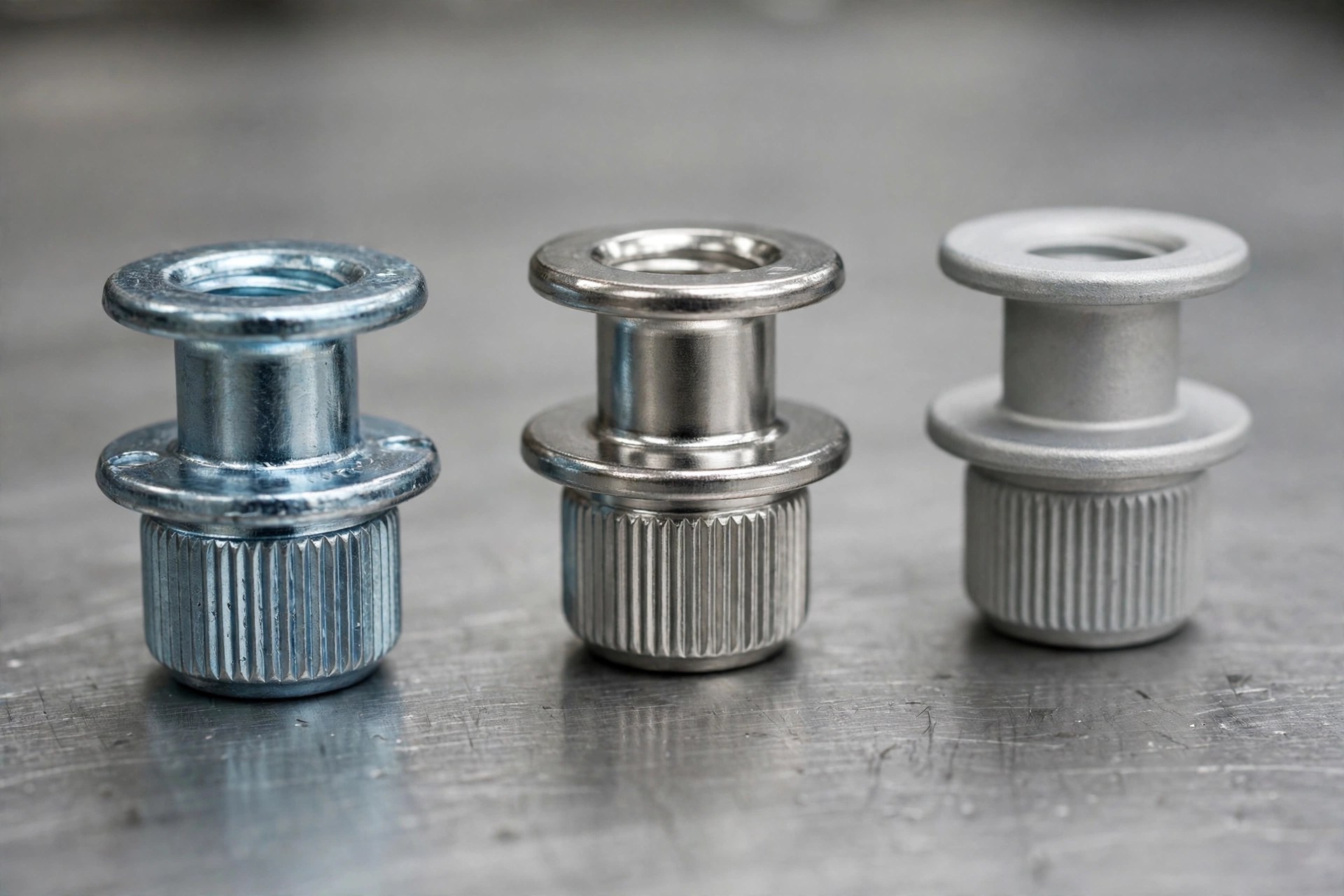
Blind rivet nuts put a reusable thread into thin sheet you can only reach from one side. The material decides whether the joint lasts: steel for strength and cost, stainless 304 or 316 for corrosion, aluminum for light weight and aluminum panels. This guide compares the three.
But once the size and head style are settled, one decision still shapes whether that joint lasts the life of the product: the material of the insert itself. Steel, stainless steel and aluminum rivet nuts look almost identical in a parts bin, yet they behave very differently once they are in service — in strength, in corrosion resistance, and in how they get along with the panel they sit in. This guide compares the three, so you can specify the right one the first time.
What a Blind Rivet Nut Has to Do
A blind rivet nut earns its place by doing three jobs at once. First, it must grip: the collapsed shank clamps the sheet from behind, and a knurled body resists spinning when the screw is torqued. Second, its thread must survive repeated assembly — panels come off for service and go back on, sometimes for years. Third, it must live with its environment without corroding, loosening or staining the panel around it.
The material decides how well it does all three. A steel insert carries the most load for its size; a stainless insert survives the harshest weather; an aluminum insert is the lightest and the kindest to an aluminum panel. There is no single best material — only the best match for the job.

Steel Rivet Nuts: The Workhorse
Carbon steel is the default blind rivet nut material, and for most indoor applications it is the right one. It gives the strongest thread for a given size, it is the lowest cost of the three, and it is available in every common head style — flat head, reduced head and countersunk — with knurled, round or plain bodies.
Steel rivet nuts are normally zinc plated. The plating is what keeps rust at bay, and in dry, indoor service it does the job for the life of the product. That makes steel the natural choice for automotive body and interior panels, appliance frames, HVAC housings and control cabinets — anywhere the joint stays dry and strength per cost matters most.
The limit is moisture. If the plating is scratched during installation, or the joint lives outdoors or in a damp environment, corrosion can start at the damaged spot and spread. So the question to ask about steel is a simple one: will this joint stay dry? If the answer is yes, steel is hard to beat. If it is no, look at stainless.
Stainless Steel Rivet Nuts: For Corrosive Environments
Stainless steel rivet nuts are made in two grades, 304 and 316, and the difference between them is worth knowing.
Grade 304 handles outdoor service, damp environments and regular washdown without rusting, and it carries a thread about as strong as a steel insert of the same size. It is the standard choice for outdoor enclosures, street furniture, food processing equipment and any assembly that gets hosed down.
Grade 316 adds molybdenum to the alloy, which gives it far better resistance to chlorides — salt spray, coastal air, de-icing salt and many chemicals. It is the grade for marine equipment, coastal installations and chemical plant enclosures — and the most expensive of the three, so reserve it for joints that genuinely face chlorides.
Two practical notes apply to both stainless grades. First, stainless threads can gall — the screw can seize in the insert — so standard practice is to lubricate the mating screw and avoid over-torquing. Second, a stainless insert in an aluminum panel can drive galvanic corrosion if the joint stays wet, because the two metals are far apart in the galvanic series. In wet service, either match the materials or isolate the joint; in dry service this is rarely a problem.
Aluminum Rivet Nuts: Light and Galvanically Friendly
Aluminum rivet nuts are the lightest of the three and the natural partner for aluminum panels and extrusions. Because the insert and the panel are the same family of metal, there is no galvanic mismatch to worry about, and the natural oxide film on aluminum gives good corrosion resistance without any plating.
The trade-off is strength. Aluminum is a softer metal, so an aluminum insert has lower thread strength and pull-out resistance than a steel or stainless insert of the same size. In practice that means sizing up the thread, or using more inserts to spread the load. For light loads — covers, trims, electronics housings, access panels — that is rarely a problem.
Aluminum is the right call where weight matters, where the panel is aluminum, and where the loads are modest: electronics housings, aluminum extrusions, lighting fixtures and fabricated aluminum enclosures.
At a Glance
| Material | Thread strength | Corrosion resistance | Weight | Best for | Watch out for |
|---|---|---|---|---|---|
| Steel (zinc plated) | High | Good indoors; fair outdoors | Medium | General fabrication, automotive, appliances | Rust if the plating is damaged or the joint stays wet |
| Stainless steel 304 | High | Very good | Medium | Outdoor, damp and washdown environments | Higher cost; threads can gall, so lubricate the screw |
| Stainless steel 316 | High | Excellent, including chloride and marine exposure | Medium | Coastal, marine and chemical environments | Highest cost of the three |
| Aluminum | Moderate | Good, from its natural oxide film | Light | Aluminum panels, extrusions, electronics | Lower pull-out strength; size up where the load is high |
How to Choose in Five Questions
- Where will it live? Dry indoors points to steel. Damp or outdoor points to stainless 304. Coastal, marine or chemical exposure points to 316.
- What is the panel made of? Match the insert to the panel where you can. An aluminum insert in an aluminum sheet avoids galvanic corrosion entirely; a stainless insert in aluminum deserves a second look if the joint will stay wet.
- How much load will the thread carry? Heavily loaded or frequently re-torqued threads belong in steel or stainless. Light loads are fine in aluminum.
- Does weight matter? In enclosures, electronics and portable equipment, aluminum inserts save weight across hundreds of fastening points.
- Does the joint need sealing? A closed-end insert seals the thread against moisture, dust and paint overspray whatever the material is — pair one with stainless steel for a wet enclosure.
Frequently Asked Questions
Q: Which blind rivet nut material is the strongest?
A: Steel and stainless steel (304 and 316) carry the highest thread strength for a given size. Aluminum is moderate — size up the thread or use more inserts where the load is high.
Q: Can I use a steel rivet nut outdoors?
A: Only if the joint stays dry. Zinc plating protects steel indoors, but if the plating is scratched or the joint stays wet, corrosion can start. Use stainless 304 for damp or outdoor service, and 316 where chlorides are present.
Q: What is the difference between stainless steel 304 and 316?
A: Grade 304 handles outdoor service, damp environments and regular washdown. Grade 316 adds molybdenum, giving far better resistance to chlorides — salt spray, coastal air, de-icing salt and many chemicals — and it is the most expensive of the three.
Q: Will a stainless steel rivet nut corrode an aluminum panel?
A: In wet service it can drive galvanic corrosion, because the two metals are far apart in the galvanic series. Match the materials or isolate the joint where the joint will stay wet; in dry service this is rarely a problem.
Q: When should I choose aluminum?
A: Where weight matters, the panel is aluminum, and the loads are modest — electronics housings, aluminum extrusions, lighting fixtures and access panels. For heavier loads, size up the thread or spread the load across more inserts.
Q: Do I need a closed-end rivet nut for a sealed enclosure?
A: A closed-end insert seals the thread against moisture, dust and paint overspray whatever the material is. Pair one with stainless steel for a wet enclosure.
The Right Material Is a Fit-and-Forget Decision
Material is not a detail to leave to the supplier. It decides whether the thread holds under load, whether the joint corrodes, and whether the panel and the insert age together. Match the material to the environment first, to the panel second and to the load third, and the rivet nut becomes a fit-and-forget joint — installed once, and still holding years later.
Hele Metal supplies blind rivet nuts in steel, stainless steel 304/316 and aluminum, in flat, reduced and countersunk heads, with knurled, round or plain bodies and open or closed ends. Browse the range on our blind rivet nuts page, or contact us with your panel material, environment and thread size, and our sales engineers will help you specify the right insert.